

-
Your Quote Is Higher Than Theirs, But That Doesn’t Mean You’re Overcharging
In May this year, I will have been in business as a signmaker for 30 years. Now that I’m “semi retired”, I have more time to reflect on the many difficulties I have experienced over the years. Like many others new to the business, I was guilty of underpricing my work in the early days. Sometimes it came back to bite me. Sometimes it didn’t. But in the long term I have come to realise there will always be someone out there that’s cheaper, and I have learned to overcome this.
So here are my thoughts based on nearly 30 years as a signmaking business owner:-
If you’ve been in sign making any length of time, you’ll know this situation well.
A customer comes back and says:
“We’ve had another quote, it’s hundreds cheaper. Can you match it?”
At that moment, the assumption is that someone is either greedy or incompetent.
In reality, both quotes are usually sincere, but they are almost never pricing the same assumptions.
The Problem Isn’t Price, It’s Invisible Scope
Most customers believe a sign is a simple object.
i.e. size, material and fixings.
They don’t see (and aren’t told) about the judgment that sits underneath.
When you price a job properly, you are pricing:
Experience, risk, responsibility, longevity, compliance.
When someone else prices cheaply, they are often pricing hope.
Hope is not dishonest, but it is fragile.
What You’re Actually Including (That They Probably Aren’t)
If your price is higher, it’s usually because you’ve quietly priced in things you’ve already been burnt by.
For example:
Design responsibility. You’re not just placing artwork, you’re deciding what will actually read at distance and speed.
Material choices that last. Not just the sheet material used, but the thickness, grade, fixings, expansion and UV stability.
Installation reality. Access, surface condition, fixings, load, weather tolerance — all considered before turning up on site.
Aftercare responsibility. You know you’ll still be answering the phone if something fails.
None of that shows clearly on a one-line quote.
Why Cheap Quotes Aren’t Always Wrong, Just Optimistic
Lower prices often assume:
The wall is sound.
Access is simple.
The artwork will “be fine”.
Nothing will go wrong.Sometimes they’re right.
But when they’re wrong, the cost lands:On you, on the customer, or on the reputation of the trade as a whole.
The cheaper quote didn’t undercut you, it underestimated the job.The Trap of Competing on Square Metres
Pricing by size alone is one of the most damaging habits in the trade.
Two signs of identical dimensions can differ wildly in:
Internal construction, fixing method, illumination quality, installation difficulty, and expected lifespan.
You wouldn’t price a vehicle by weight alone. Yet we’re often pushed to price signs the same way.
Resist it.Why You Feel Awkward Explaining Your Price
Most sign makers aren’t uncomfortable with pricing because they’re expensive.
They’re uncomfortable because:
They haven’t written down what they’re actually including.
They assume customers don’t want the detail.
They worry explanation sounds like justification.In reality, silence makes your price look arbitrary.
Clear explanation makes it look deliberate.The Question You Want the Customer to Ask
Instead of:
“Why are you more expensive?”You want them asking:
“What problems does this price prevent?”That’s where experience shows, and that’s where your value lives.
A Hard Truth About the Trade
If you price as if:
Nothing will go wrong.
Everything will fit.
No one will complain.
Materials will behave perfectly.Then sooner or later, your margin will pay the price.
Experienced sign makers don’t charge more because they’re greedy.
They charge more because they’ve already learned what cheap mistakes cost.The Shift That Changes Everything
Stop thinking of your quote as a number.
It’s a risk transfer document.
You’re telling the customer:
“If something goes wrong, this is what it costs me to stand behind it.”Price accordingly.
Why This Matters
When you explain pricing properly:
You lose fewer jobs.
You attract better clients.
You stop apologising for being competent.
You protect your margins and your sanity.And perhaps most importantly:
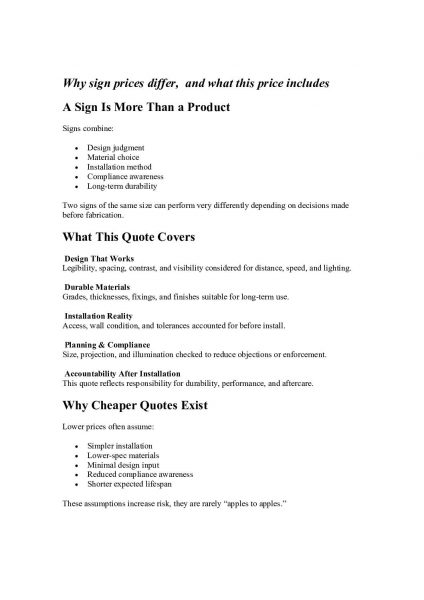
You stop racing people who aren’t running the same race.I believe you should explain to your customers the reason why your quotation may be higher than your competitors’ price. The download attached is designed as a document to include with your quotation.



Log in to reply.