

-
Giant 3D billboards set to become a reality!

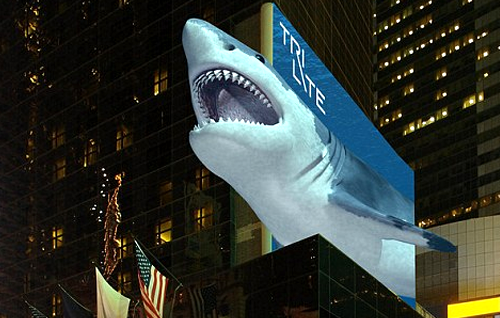
Researchers claim to have cracked the problem of creating giant displays that can show images in 3D without the need for glasses. Austrian researchers have developed a laser system that sends different images to each eye – and say it could lead to New York’s Times Square having its first 3D ads. It would mean the 3D billboards seen in Back to the Future II, set in 2015, could finally become a reality.
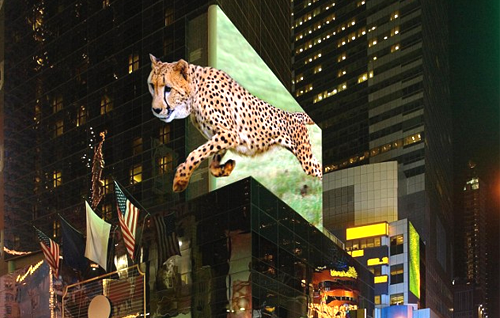
It could also mean the end of having to don cumbersome glasses at the cinema, they say, and be used to show sporting events on huge screens in 3D – allowing hundreds of people to see the image at the same time. The sophisticated laser system sends laser beams into different directions.
The system is similar to holographic billboards seen in Back to the Future II, advertising Jaws 19:
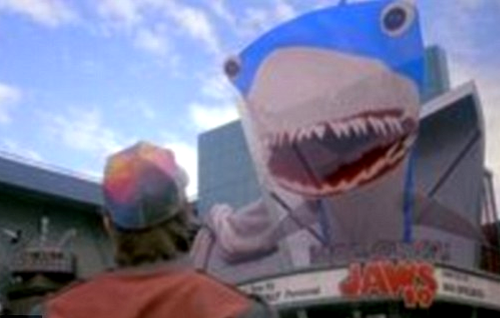
Therefore, different pictures are visible from different angles. The angular resolution is so fine that the left eye is presented a different picture than the right one, creating a 3D effect. ‘Marty McFly, the protagonist of the movie ‘Back to the Future Part II’, uses a time machine to travel from the year 1985 to October 21st, 2015,’ the firm behind the technology. TriLite, says.
Each Trixel has been equipped with three different lasers (red, green and blue):
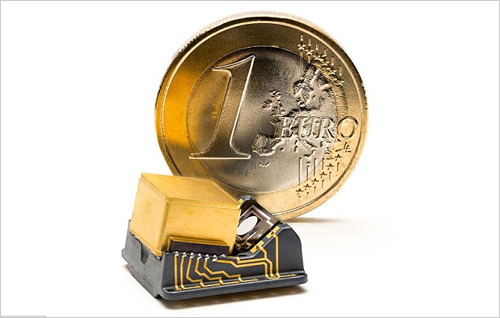
‘In the technological utopia of 2015 he is in for quite a few surprises. One of them is a colossal display on top of a cinema, from which a terrifying 3D shark seems to jump out to get him. ‘Back in the 80s, no viable concepts for such a 3D display technology existed. But today, this technology is within reach.’ A first prototype was been developed by TriLite Technologies and TU Wien a few months ago. Each 3D pixel (called ‘TrixelTM’) consists of a laser and a moveable mirror. The mirror directs the laser beams across the field of vision, from left to right. During that movement the image information is changed. With this basic idea, different pictures can be sent to the viewer´s left and right eye, so that a 3D effect is created without the need for 3D glasses. Now, a much more advanced second prototype has been presented. It is now a full colour display, a significant advancement over the first monochromatic version. Each Trixel has been equipped with three different lasers (red, green and blue). The module consists of 12×9 Trixels, so any number of modules can be assembled to create a large outdoor display. ‘The software for controlling the modules and displaying movies has already been developed’, says Jörg Reitterer.
The mirror directs the laser beams across the field of vision, from left to right. During that movement the image information is changed. With this basic idea, different pictures can be sent to the viewer´s left and right eye, so that a 3D effect is created without the need for 3D glasses:
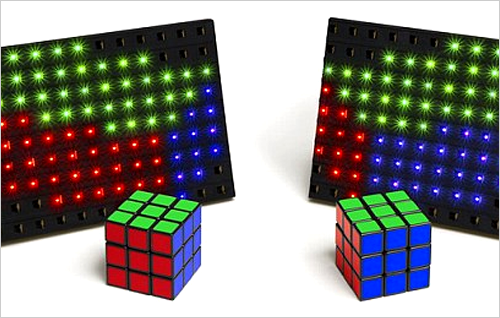
‘We can use any off-the-shelf 3D movie and play it on our display.’ ‘The basic technology was invented by TriLite Technologies in 2011,’ said says Franz Fidler, CTO of TriLite Technologies. ‘At TU Wien, three research institutes worked on different tasks such as steering the Trixels and optimizing the connection between them. ‘The technology is now ready for the market, and we are looking for partners for mass production all over the world’, To experience the 3D effect, the viewer must be positioned in a certain distance range from the screen. If the distance is too large, both eyes receive the same image and only a normal 2D picture can be seen. The range in which the 3D effect can be experienced can be tuned according to the local requirements. 3D movies in the cinema only show two different pictures – one for each eye. The newly developed display, however, can present hundreds of pictures. Walking by the display, one can get a view of the displayed object from different sides, just like passing a real object.
For this, however, a new video format is required, which has already been developed by the researchers. ‘Today’s 3D cinema movies can be converted into our 3D format, but we expect that new footage will be created especially for our displays – perhaps with a much larger number of cameras’, says Franz Fiedler, CTO of TriLite Technologies. Compared to a movie screen, the display is very vivid. Therefore it can be used outdoors, even in bright sunlight. Electronic Billboards could display different ads, seen from different angles.
‘Maybe someone wants to appeal specifically to the customers leaving the shop across the street, and a different ad is shown to the people waiting at the bus stop’, says Ferdinand Saint-Julien, CEO of TriLite Technologies.
.

Sorry, there were no replies found.
Log in to reply.