

Home › Forums › Sign Making Discussions › General Sign Topics › Grenfell Tower fire, Aluminium Composite Material – Is this a fire hazard?
-
Grenfell Tower fire, Aluminium Composite Material – Is this a fire hazard?
Posted by Phill Fenton on 15 June 2017 at 08:18Early reports suggest that ACM cladding was the cause of the horrendous fire that engulfed a London flat yesterday. Is this the same stuff so beloved of signmakers these days and if so is there likely to be an impact on our industry?
John Singh replied 8 years, 6 months ago 13 Members · 21 Replies -
21 Replies
-

I noticed a new tower build near us, is using a composite panel for cladding. Can’t remember the brand but it was the brand I recognised whilst driving past.
I’m not sure how combustable the panels alone would be, perhaps it’s the insulation behind, or the way they’ve been installed?
-

I would imagine the premium brands have a fire rating Phill, but it does make you wonder about all the cheap chinese imports that are on the go because there are loads more of those than the quality brands.
I haven’t heard that, but makes sense because you could see so much… what looked like dripping plastic in flames falling away from the building.
-

I’ve had a quick look into what type of ACM was used, and it seems it was different to the stuff that we all use.
The cladding on the building was an Aluminium Composite Material, but the core was made out of a polyurethane foam as opposed to the polyethylene core that we all work with.
Still, I think this might have some impact on the sign industry
-

a report I listened to on local radio said it was Renobond / reynobond (however you spell it). I was tempted to throw a bit on a bonfire and see what happens but I’m certain it’s a different product to what we use.
-

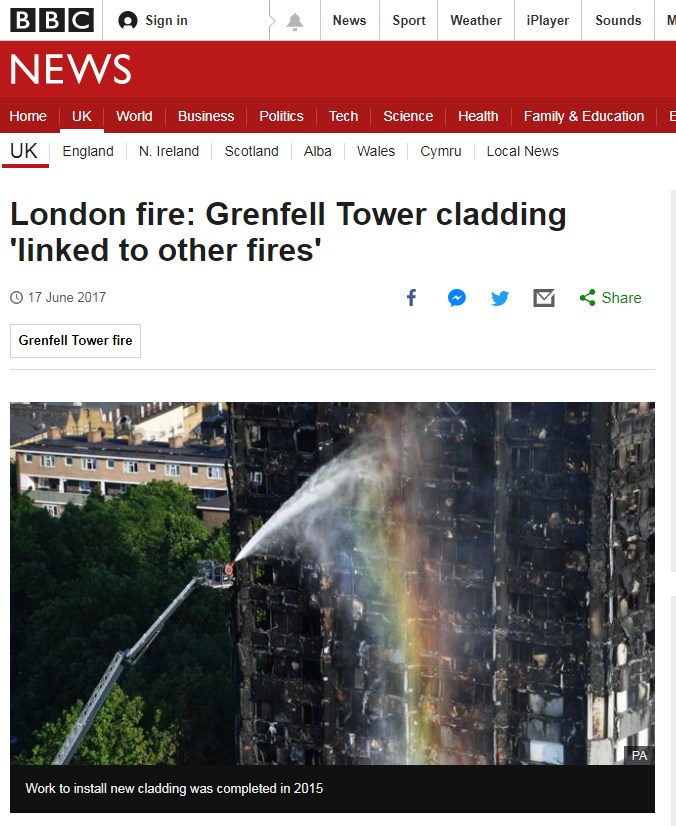
According to this BBC news report, it would seem that it was indeed a polyethene core;
http://www.bbc.co.uk/news/uk-40283980
Be interesting to see what happens going forward regarding the use of such panels…
Attachments:
-

We did a massive job for our client who was printing for the London Underground…all the ACM used was fire rated I believe we used Reynobond which was a material TFL had tested for fire rating, I think the public inquiry which everyone is calling for will soon reveal the truth
Reports suggest that it was expandable foam used behind the panels which caused the fire to roar out of control!
-

I read some where that a non fire rated insulation between the Ali comp panels and the concrete building was used. It’s scary that this has happened and how many other buildings may have the same issue.
-

I believe that a year ago, or maybe two, there was a similar fire that engulfed a building somewhere in the middle east, could have been Dubai. I don’t recall the same loss of life but I do remember that it was thought, on the day, that a composite cladding material was responsible for the rapid spread of flame.
-
quote :Reports suggest that it was expandable foam used behind the panels which caused the fire to roar out of control!
Spot on James – the main issue is what’s behind the ACM sheet.
Insulation materials such as cellotex are treated as a combustible material (once ignited they also burn quickly). The ACM panel then acts as a funnel / chimney further accelerating the spread of fire as it races towards the oxygen, in turn the panel delaminates, producing ‘fire droplets’ of molten aluminium & plastic.This is why a lot of countries limit the height of cladding as used here.
The ACM panel on its own isn’t the biggest problem – its what’s behind & how its fitted (air gaps, fixing materials..).
Fire Brigade had issues years ago with ACM panels used in food hygiene prefabs – the panel clips were plastic, so melted in a fire allowing walls & ceiling to collapse.
Terrible fire & the building control inspectors (The local council) are going to have a lot of explaining to do, as is the government (we are on of the only European countries that allow a single exit staircase in tower blocks!!)
-

Unfortunately guys it was Reynobond PE (polyethylene) similar to what we use, Don’t think its actually flammable on its own but in fire situation turns in to little balls of fire and red hot metal also gives of acrid smoke
https://www.theguardian.com/uk-news/201 … -exteriors
-
Reynobond PE isn’t fire rated the FR version is…I do hope these contractors didn’t go for PE over the FR just to save on costs.
-
See Video below
$this->BBvideo_pass(‘$8’, ‘$4’, ‘$7’)
Attachments:

-

So its the insulation in between the composite board
I did wonder because they said it was for insulation purposes why it was fitted and you would not think straight away of raynobond or dibond being used in such a way. It would be more of a cosmetic finish to the insulating core
-
So is Dibond and other makes fire safe?
We could boast of its quality and longevity and other aspects but this leaves me a little shaky in recommending to clients
-
I think that the manufacturer of Dibond, Reynobond or any named ACM would have a spec sheet on their website or available by phone, failing that then your supplier should be able to provide one for the product.
It might be wise in the to be able to provide those details for any sign that is to be fiited into an indoor area. -
BBC News reporting this morning, that is the ACP they’re testing.
1 authority has a certificate from the manufacturer/installer stating the panels are class 0 rated, however when the government has tested, it’s come back as class 3, and needs to be removed.
Whether they’re testing in the same manner, I don’t know.
Concerns seem to be that the ACP delaminates, exposing the core, which burns and spreads the fire.
I’m quite surprised that the ACP seems have been a rather large contributing factor in the fire.
-
Watching the news this morning I saw them removing the boards, looks too thick to be the same 3mm stuff we use, the way they’re handling it makes me think their stuff is much lighter too.
Do we have a confirmed product name / spec yet?
-
If you think about it composite board is being used right across the industry not just signs



Log in to reply.